Best alternative to Cloudflare, meet Defenso.
Cloudflare is a leading CDN and edge WAF. Defenso is not a replacement for it. It is the application-layer security and monitoring most teams still add on top: pentest, repo scanning, uptime and a phone alarm. Many run both.
Why teams pick Defenso over Cloudflare.
Let us be clear up front: Cloudflare is excellent, and Defenso does not try to replace it. Cloudflare's global CDN, DDoS absorption and edge WAF are best-in-class, and if you already run your DNS through Cloudflare you should keep it. This is not a "Cloudflare is bad" page. It is about the gap Cloudflare was never designed to fill: the application-layer security and monitoring that lives closer to your code.
Cloudflare protects at the edge, in front of your origin. Defenso protects inside your app through a one-line SDK, so it sees the request the way your framework does and can rate-limit specific endpoints, block risky payloads per route and log the exact rule and payload that fired. It also does the things a CDN was never meant to: a scheduled pentest that grades your site A to F, repo and secret scanning that catches a leaked key before an attacker does, uptime and SSL and domain-expiry monitoring, and a call-style phone alarm for the 3am incident. Most Defenso customers run it behind Cloudflare, not instead of it.
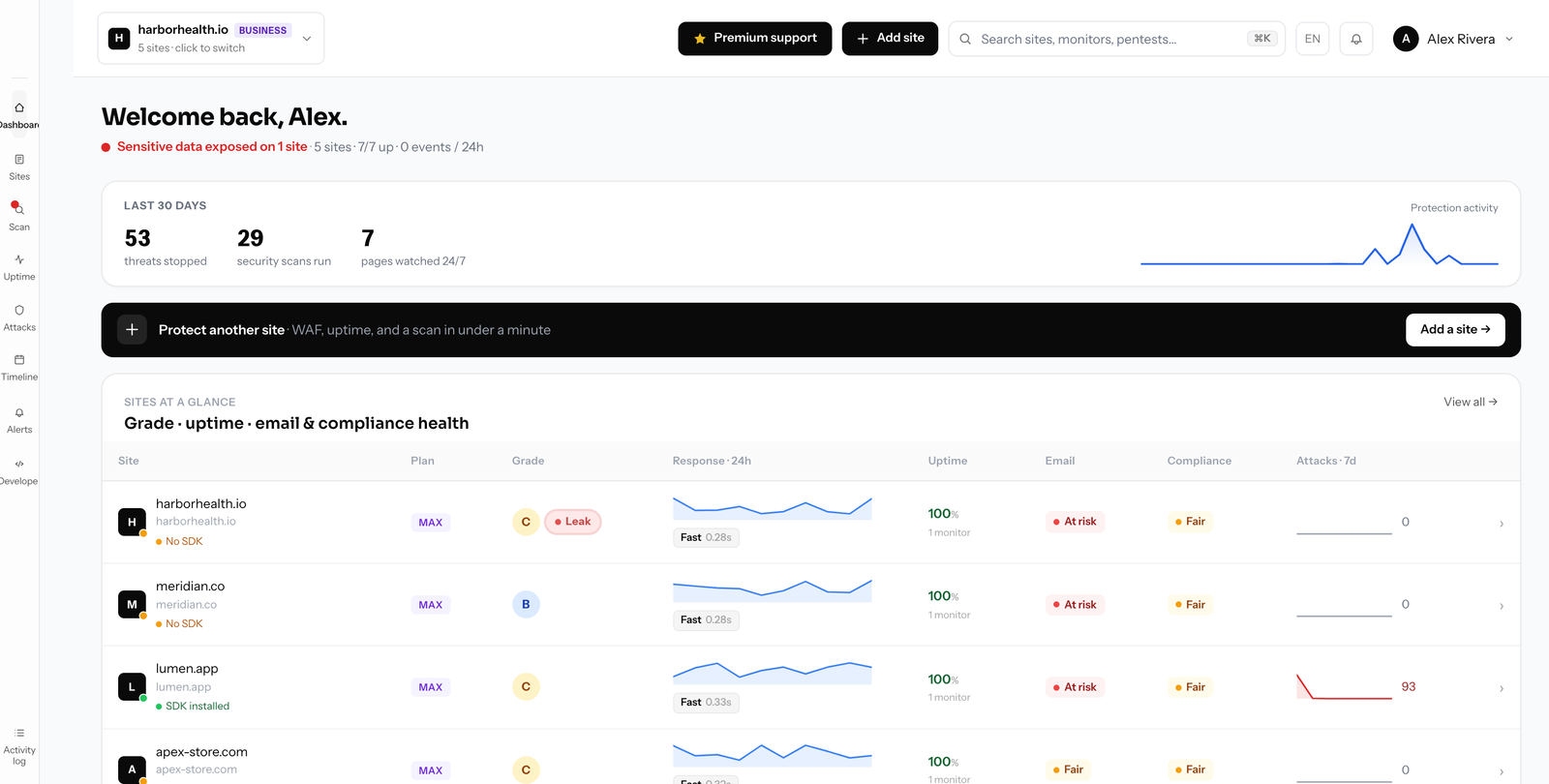
Switching from Cloudflare to Defenso.
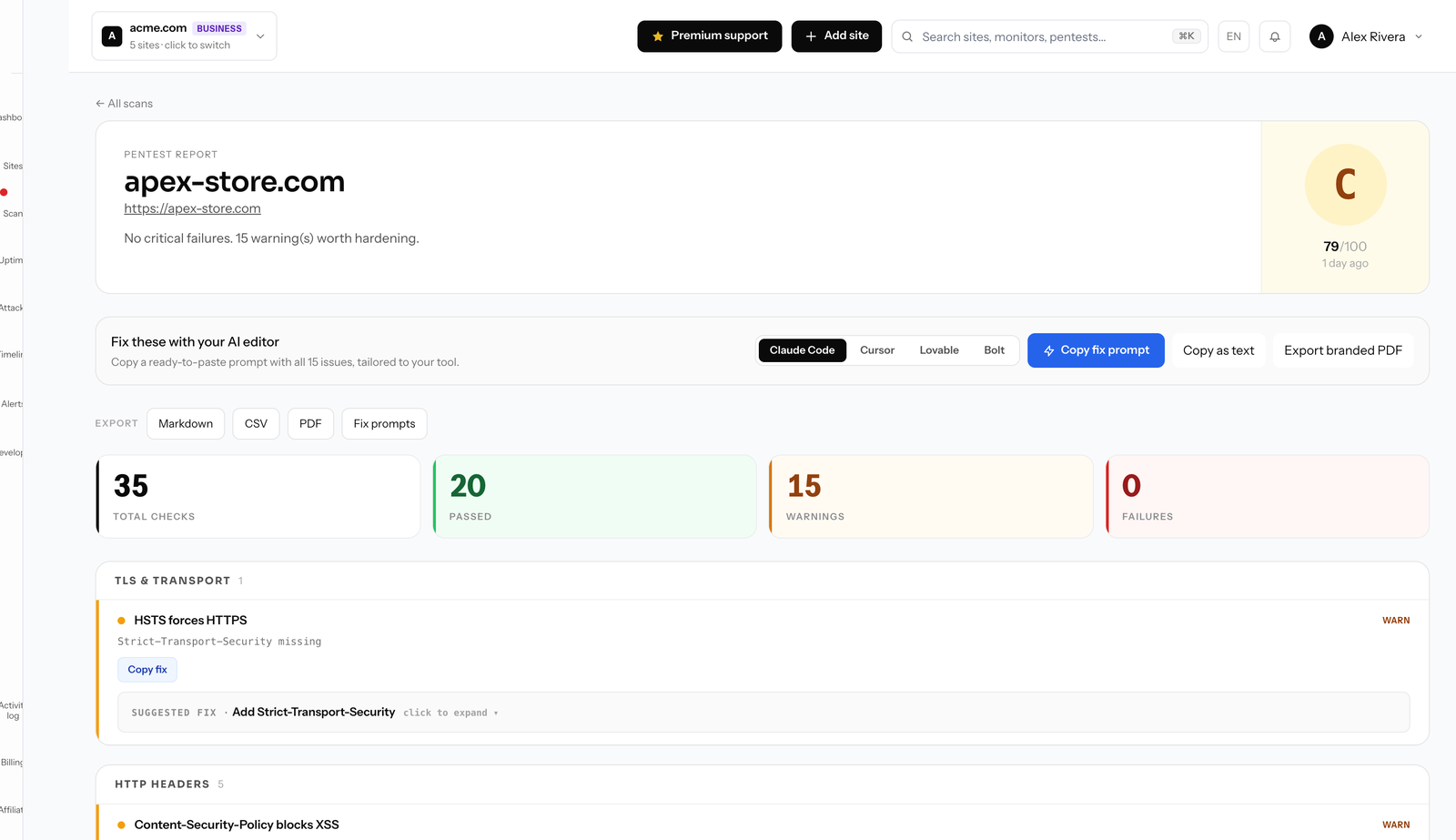
The practical setup: keep Cloudflare in front for CDN and volumetric DDoS, and add Defenso for the application layer. Defenso's managed WAF installs in one line and fails open, so it never becomes a single point of failure: if Defenso is unreachable your traffic still flows. Because it runs inside the app, its rate limits are per-endpoint and per-account, not just per-IP at the edge, which is what actually stops credential stuffing and API abuse.
Where Defenso goes well beyond a WAF is coverage. The same account runs a monthly pentest and security scanner against your live site, scans connected repositories for committed secrets and vulnerable dependencies, watches uptime from multiple regions with SSL and domain-expiry alerts, and pushes a call-style alarm to your phone the moment something breaks. Cloudflare does none of that, because it was never meant to. It is a network, not a security-and-monitoring platform for your application.
There is no migration to do, because there is nothing to migrate off. You keep Cloudflare exactly as it is and add Defenso beside it: connect a site, drop in the SDK, and the app-layer protection, scanning and monitoring turn on. The free tier needs no card, so you can add it to one site today, and annual billing runs about 25% under the monthly rate.
Compare Defenso with the rest.
How to switch from Cloudflare without a monitoring gap.
Migrating off Cloudflare is a five-minute job, not a project. You keep Cloudflare live while you set Defenso up, move your sites and alerts across, switch on the WAF and pentest Cloudflare never offered, and only then cancel. Here is the exact order.
-
01
Keep Cloudflare running while you set up
No rip-and-replace. Create a free Defenso account and add your sites there first, and Cloudflare stays live the whole time, so there is never a monitoring gap during the move.
-
02
Add your sites and endpoints
Point Defenso at the same URLs, domains and API endpoints you watch in Cloudflare. Uptime checks, SSL and domain-expiry monitoring and a public status page turn on the moment a site is added: no agent to install, no DNS change.
-
03
Wire up the alerts you already use
Connect email, Slack, Discord, Telegram or a signed webhook, and install the Defenso Alerts phone app. The call-style Alarm level rings through silent mode and Do Not Disturb for the 3am outage you cannot sleep through, something Cloudflare cannot do.
-
04
Turn on the security Cloudflare does not have
This is the real upgrade: a managed WAF in one SDK line, a scheduled pentest that grades your site A–F, repo and secret scanning, and active deception, all in the same account, at no extra vendor. Monitoring and security stop being two bills.
-
05
Run both for a cycle, then cancel Cloudflare
Watch the two side by side for a billing cycle. Once you trust the Defenso alerts and grades, cancel Cloudflare and consolidate. Most teams find they were paying for uptime and still had no security layer at all.
Frequently asked questions.
Everything people ask before they switch from Cloudflare. Still unsure? We are one message away.
No, and it does not try to be. Cloudflare is a CDN and edge WAF; Defenso is application-layer security and monitoring (pentest, repo scanning, uptime and a phone alarm) that runs inside your app via a one-line SDK. Most customers run Defenso behind Cloudflare.
Yes, that is the recommended setup. Keep Cloudflare for CDN and DDoS at the edge, and add Defenso for per-endpoint rate limits, a scheduled pentest, repo secret scanning and uptime alerting. The Defenso SDK needs no DNS change, so it slots in without touching your Cloudflare config.
A scheduled pentest that grades your site A to F, repository and secret scanning, uptime and SSL and domain-expiry monitoring, a call-style phone alarm, MCP tools for AI editors, and a compliance generator. Cloudflare is a network layer; these are application-security and monitoring features it was never built to provide.
No. The SDK adds about 4ms and fails open, so if Defenso is ever unreachable your traffic keeps flowing on a cached policy. It sits inside your app rather than adding another network hop, so Cloudflare still handles the edge and CDN exactly as before.
Get more than monitoring, for free.
No card, no install. Add a site and get uptime, a managed firewall, a pentest and a phone alarm in one account.